
Why i choose to use force free dog training methods
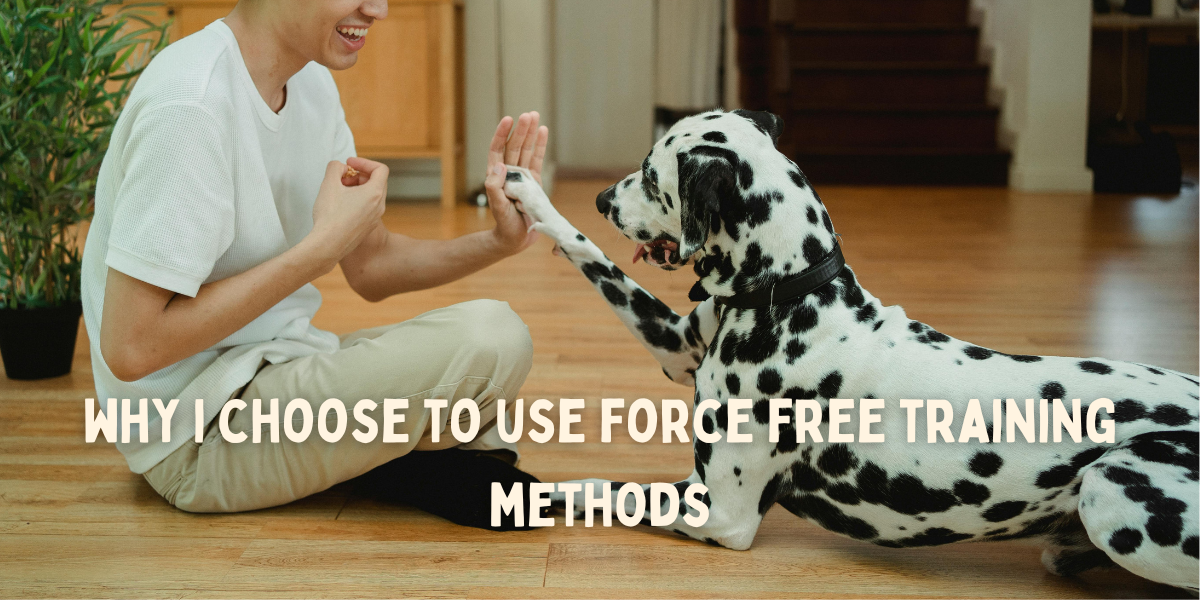
I describe myself as a Force Free dog trainer to help clients know what they can expect if they choose to work with me. But I know that ‘force free’ means many different things to different people.
For me, being a force free trainer means that I:
Prioritise the welfare and safety of both the dog and human
Use only ethical training methods
Do not use fear or force to coerce dogs into behaving in a particular way
Act and communicate professionally at all times
Adhere to the Code of Conduct of both PACT and the ABTC
My approach to training dogs as a Force Free trainer is to help my clients to understand their dog, read their body language and know what they need. It can be tempting to constantly micromanage our dogs, or only offer them attention when they’re doing something we don’t like. Instead I use management as a way to prevent dogs from getting into trouble, whilst also using games and positive reinforcement to help them learn to make good choices.
I do not use aversive training methods such as leash corrections, choke chains, prong collars, electric shock collars (e-collars), anti bark collars, pet corrector sprays or anything else that suppresses a behaviour using fear or pain. Because dogs already have so little control over their lives, using methods that restrict choice and ignore their welfare needs are not only unethical but also contradict the Code of Practice for the Welfare of Dogs.
The problem with using aversive methods to change behaviour is that they don’t address the root cause. Stopping the ‘problem behaviour’ without addressing the cause only serves to make things easier for the human, it does not actually address what the dog needs. The risk of this is that behaviours can escalate, it can increase fear or anxiety, damage the dog’s relationship with their humans and the level of force may need to be continually increased to remain effective.
Being a member of the Professional Association of Canine Trainers (PACT) and the Animal Behaviour and Training Council, means that I am required to follow and adhere to the Code of Conduct for both organisations. It is incredibly reassuring to know that I can trust that other members of these organisations uphold the same standards of ethics, integrity and professionalism that I do. This sense of community over competition means that we can all work alongside each other to offer support, help each other grow and refer on to trusted professionals when something falls outside our area of expertise. The role standards defined by the ABTC also mean that nobody is working beyond their own knowledge or level of experience.
I am currently a dog trainer, but am working towards the additional role of Animal Behaviour Technician (ABT). This will mean that I am able to offer behavioural first aid for dogs who are displaying ‘problem behaviours’. This includes assessing whether the dog’s needs are being met and offering advice on how to meet their needs, making recommendations for keeping everyone safe and implementing measures to prevent the problem behaviour from getting worse. Although any diagnosis should be made by a qualified Clinical Animal Behaviourist, I am also able to support the implementation of a behaviour plan.
REFERENCES